


Introduction
GST (pronounced gist, Twitter/X: @wearegst) has earned a genuine place in Nigeria’s civic media landscape. In a country where mainstream newsrooms are usually compromised by commercial and political interests, the arrival of a platform that claims to be committed to democratic accountability and civic mobilization is in principle a good thing and should always be welcome.
But moral credibility should not lead to editorial immunity. And it is precisely because GST matters [because it commands audiences of thousands of Nigerians on the questions it chooses to campaign on] that its methodology deserves serious, evidence-based scrutiny.
GST’s reporting on at least three recent public interest issues: Nigeria’s tax reform, Milo and childhood nutrition, and the regulation of powdered milk, has been misleading, decontextualised, and in the case of the milk campaign, potentially harmful to the very Nigerians it claims to serve.
What is GST?
To be fair, GST does not describe itself as a neutral news outlet. Its founder and CEO, Adewunmi Emoruwa, has been explicit about this. In a 2026 profile by Communiqué, a media trade publication, he stated: “We are not going to be strictly bound by the entire idea of objectivity. So we are going to editorialize from the start. We’re going to give people the truth.” Elsewhere he described the platform as “a news movement of sorts, but really, it is a sort of social justice community.”
This is an important distinction. GST is not journalism in the conventional sense. It is advocacy journalism [a hybrid model in which content production is explicitly instrumental to campaign goals]. Its own described formula is: story → campaign → pressure → response. It appears that for GST, “content” is a tool for mobilization, not primarily for informing. This is not inherently wrong and advocacy organizations worldwide use media to advance policy change. The problem arises when this model is applied to complex, evidence-dependent scientific and economic questions [and when the audience, which largely encounters GST as a news source, is not made aware of the distinction].
This matters structurally, too. GST’s primary confirmed funder is the National Endowment for Democracy (NED), a Washington DC-based body funded by the United States Congress whose stated mission is to “fuel liberty” globally. A separate NED-funded fellowship, run in partnership with Communiqué Academy, feeds content directly into the GST platform. NED is a legitimate democracy promotion institution, and its support for Nigerian independent media has genuine value. But a media platform that takes no advertising, relies primarily on a foreign institutional funders with a declared advocacy mandate, and explicitly rejects journalistic neutrality is something Nigeria’s audience deserves to understand when consuming its content [especially when that content makes specific empirical claims about health and economics].
None of this makes GST wrong about everything. It makes it necessary to evaluate GST’s claims the same way we would evaluate any other advocacy organization’s claims: on the evidence, not on the organization’s stated intentions.
Part I: The 2025 Tax Campaign
In late 2025, Nigeria’s National Assembly was debating a major tax reform package under the framework of the Nigeria Tax Act (NTA). The reform, led by Taiwo Oyedele, Chair of the Presidential Fiscal Policy and Tax Reform Committee, was designed in part to rationalise and simplify Nigeria’s notoriously complex tax system. Oyedele claimed a stated objective of theirs was protecting lower-income earners while broadening the tax base.
GST launched an accompanying #RejectTaxScam campaign. One widely circulated post declared: “This is about our money, our rights. It’s not theirs to seize. Post your call. Share it. Tag them. rejecttaxscam.com.” The campaign used emotionally charged language and called on Nigerians to actively resist the reform.
Another post illustrates a specific type of analytical failure [that has become commonplace with GST]. Commenting on the government’s announcement that those earning below ₦800,000 per year would not be taxed, GST responded: “This isn’t a win. The government says people earning below ₦800,000 a year won’t be taxed. But ₦800,000 a year equals just ₦66,600 a month which is below the minimum wage of ₦70,000. That means almost everyone earning a salary will be affected.”
This framing had a surface-level plausibility that made it effective as a campaign message. The calculation is arithmetically correct. But it is analytically incomplete in ways that matter enormously for public understanding. The NTA 2025, as enacted, introduced a progressive rate restructuring and not a flat across-the-board increase. The reform raised the personal income tax-free threshold, introduced lower effective rates for middle-income earners, and restructured higher bands. Oyedele, in multiple public addresses both before and after the Act’s passage, consistently argued that workers earning the minimum wage and below would pay zero personal income tax under the new framework, and that the overall burden on formal-sector workers earning typical Nigerian salaries would decrease or remain neutral in many brackets.
The reform was not without legitimate criticism, particularly regarding the VAT components, its implementation timeline, and the treatment of informal sector workers. Those are real debates worth having. But GST’s campaign did not engage these nuances. It painted the entire reform as a tax seizure affecting “almost everyone,” generating fear and mobilising opposition on grounds that the evidence did not fully support.
Interestingly, when the Act was passed, it [so far] demonstrably favoured lower earners in key provisions, GST issued no correction, no follow-up, and no reassessment of its campaign claims. The rejecttaxscam.com campaign materials remain online as of the time of writing without a post-enactment correction.
For an organisation that claims civic accountability as its mandate, this specific pattern of aggressive public mobilisation based on incomplete analysis, followed by silence when the analysis proves overstated, is a serious editorial and organizational failure.
Part II: The Milo Campaign
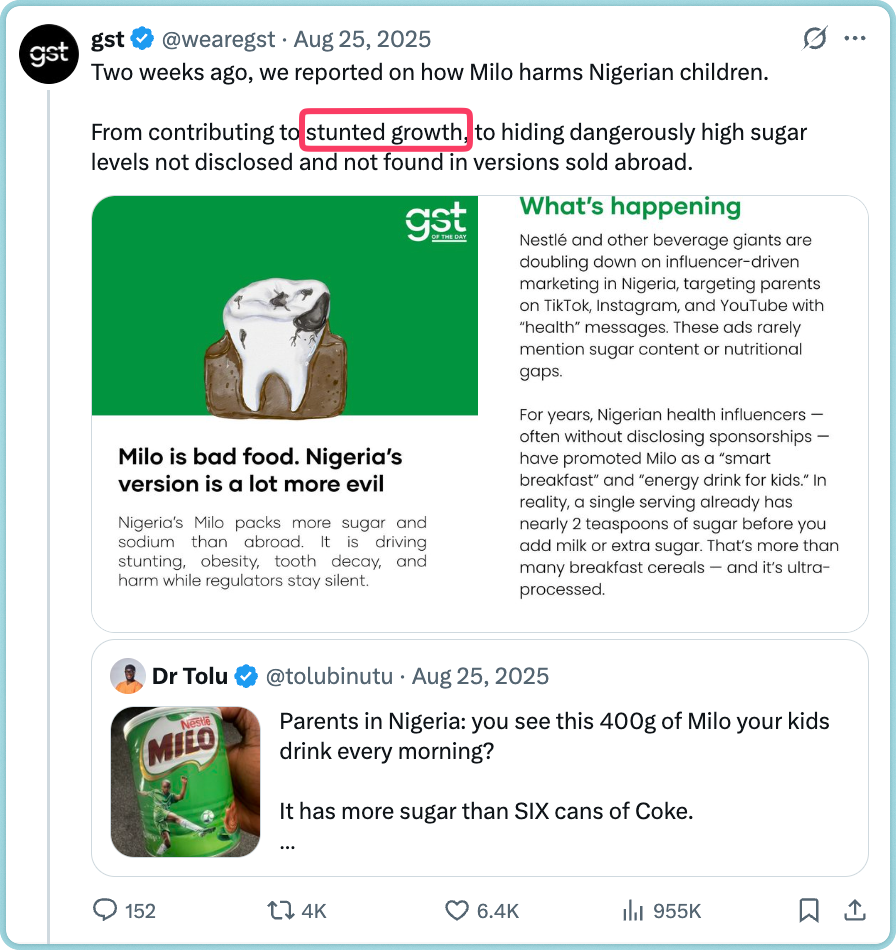
GST’s campaign against Nestlé’s Milo in Nigeria has ran across multiple posts since 2025. The core of their advocacy framing can be summarised below:
“Nigerian Milo is a sugar bomb sold as nutrition” (April 10, 2026)
“Milo is bad food. Nigeria’s version is a more evil” (August 25, 2025)
“Nigeria’s Milo packs more sugar and sodium than abroad. It is driving stunting, obesity, tooth decay, and harm while regulators stay silent” (August 25, 2025)
This core empirical claim — that Nigerian Milo has a different formulation from versions sold in other markets, with higher sugar content — has some basis. This differential formulation has been reported independently by journalists and health researchers across West Africa. The concern about sugar overconsumption and its health effects is legitimate and well-supported by global health literature. None of this is disputed.
Again, the problem is not that GST raised the question. The problem is what it thinks the answer is.
The claim that Milo is “contributing to stunted growth” and “driving” malnutrition in Nigeria is both an attribution claim and a causal argument. And as causal arguments usually go, it is poorly constructed for the Nigerian context. Nigeria’s childhood malnutrition crisis is not primarily driven by the dietary habits of households that can afford to purchase branded powdered beverages. It is driven by poverty [with a capital letter P]. According to the World Bank and UNICEF joint estimates, approximately 36.5 percent of Nigerian children under five suffer stunting, with the most severe prevalence in the North West and North East regions [precisely the poorest, least food-secure zones in the country, where access to Milo and branded food products of any kind is limited]. The drivers of this crisis are poverty, food insecurity, poor water and sanitation, and inadequate health services, not the formulation of a beverage that the majority of stunted children’s families cannot regularly afford to buy.
A more rigorous framing would be: “Nestlé’s differential sugar formulation for Nigerian Milo compared to European markets raises a legitimate equity and regulatory question — why are Nigerian consumers subject to a less nutritionally optimised product than European consumers?” That is a fair question, and it warrants regulatory scrutiny of both Nestlé and NAFDAC.
But GST’s framing: “Nigeria’s Milo is mostly sugar,” “it is driving stunting”, implies a direct causal relationship between Milo consumption and malnutrition that the evidence does not support. Worse, by attaching Nestlé’s product to Nigeria’s most emotionally resonant public health crisis [child malnutrition], the campaign risks becoming an agenda that, if internalised by parents who can actually afford Milo, could prompt them to substitute it with products offering less nutritional value, or simply reduce caloric intake in an already food-insecure environment.
Dietary interventions in low-income settings must account for the realistic alternatives available to the target population. The GST campaign/“journalism” does not do this.
Part III: The Milk Campaign
The most recent and arguably most consequential example is GST’s campaign on Fat-Filled Milk Powder (FFMP).
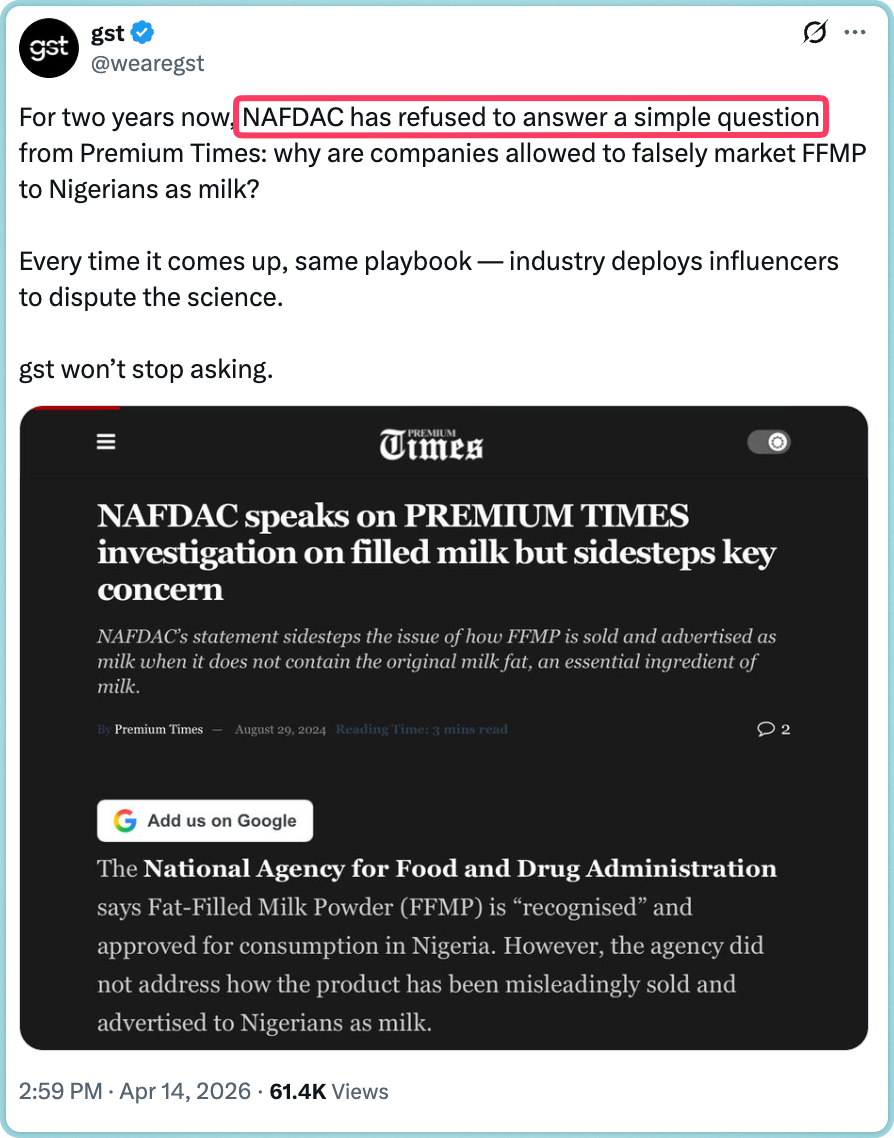
The campaign’s key claim (April 14, 2026) is: “Most Nigerians think they are drinking milk. They are drinking Fat-Filled Milk Powder (FFMP). In the EU, FFMP can’t be sold as milk, it must be labelled as a milk ingredient, not a dairy product. Here, it’s ‘milk’. Nigerians are eating what others aren’t allowed to call food.” An accompanying graphic labels Nigeria “a dumping ground for substandard milk.”
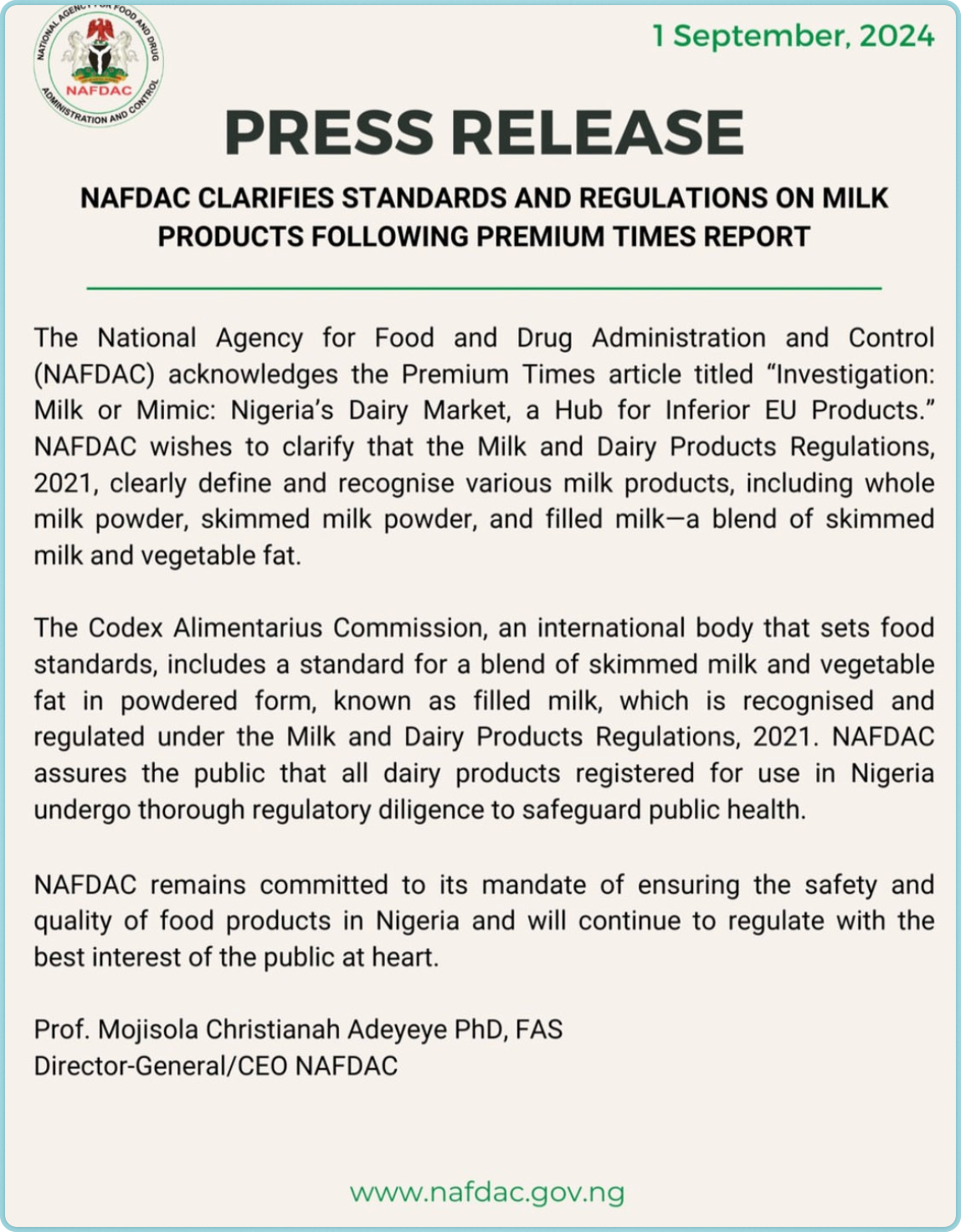
The campaign further accused NAFDAC of regulatory complacency. In actual fact, NAFDAC publicly responded to GST’s questions on this matter prior to the campaign’s escalation, providing regulatory context and clarification. GST has never acknowledged this response in any of its published content.
So, let us engage with GST’s core claim honestly.
What is true: FFMP is not whole milk. It is made from recombined skimmed milk powder and vegetable fat [typically palm oil or coconut oil. EU regulations do indeed require it to be labelled as a milk ingredient rather than as milk. The labelling standards in some Nigerian products marketing FFMP as “milk” or “dairy drink” are arguably inconsistent, and regulatory clarity on labelling would benefit consumers. These are legitimate consumer protection issues.
What is misleading: The campaign frames EU regulatory categorisation as equivalent to “food that others aren’t allowed to call food”, as if FFMP is a harmful or dangerous product. This is not supported by the nutritional evidence.
FFMP, particularly fortified FFMP as sold in Nigeria, is a recognised and nutritionally significant food product in low and middle-income countries. The WHO and FAO both recognise fortified FFMP as a cost-effective vehicle for delivering essential micronutrients [particularly calcium, vitamins A and D, and protein] in populations where fresh dairy is inaccessible. Again, Nigeria is a country dealing with systemic and entrenched poverty, hence its use in Nigeria is not incidental.
Fresh milk is perishable. This is a country where more than 70 percent of households have poor electricity access, the consumption of fresh dairy products at the scale needed to replace FFMP is simply not viable. Dry foods, including dried fish, dried beans, powdered eggs, and FFMP, are consumed because they are appropriate to the infrastructure conditions in which most Nigerians live.
Furthermore, for many low-income households, FFMP represents an accessible, affordable source of protein and calories at a price point that fresh dairy [even where available] cannot match. The suggestion that Nigerians consuming FFMP are being harmed by a product “others aren’t allowed to call food” is an egregious lie and also ignores what those Nigerians would actually consume in FFMP’s absence.
The comparison to EU labelling standards is particularly troubling as an analytical framework. The EU’s milk labelling rules are written in the context of a European food supply in which fresh whole milk, semi-skimmed milk, and a wide range of dairy alternatives are universally available, affordable, and cold-chain supported. Applying those labelling standards as a benchmark of product quality to a Nigerian market with fundamentally different infrastructure, income levels, and food security conditions is at best context-free advocacy. At worst, we can call GST’s agenda regulatory standards imperialism: which is basically importing the regulatory assumptions of wealthy, cold-climate, high-infrastructure countries and applying them to a tropical, low-infrastructure, protein-deficient food system in which the calculus of harm is entirely different.
If Nigerians were successfully mobilised by this campaign to distrust and abandon FFMP without a viable, accessible, affordable alternative being offered [and no such alternative is presented in GST’s content] the public health consequences could be severe. Anti-vaccine campaigns for example are superficially plausible advocacy producing catastrophic outcomes by causing populations to abandon an imperfect but protective intervention without anything to replace it.
Conclusion
None of this argues that GST should not exist, or that its work lacks value. Its accountability journalism on governance, elections, and political power has been substantive and necessary. Its role in supporting journalists during #EndSARS and in challenging government overreach is part of Nigeria’s democratic record.
But accountability journalism that is not itself accountable is not a public good. David Hundeyin [failed Nigerian journalist turned Russia-state propagandist] is a classical example of this.
Nigeria’s public health and economic challenges are not simple stories of corporate exploitation and regulatory failure. They are stories of poverty, infrastructure collapse, inadequate state capacity, and the genuine difficulty of making good decisions under structural constraints that most of GST’s international institutional funders have never had to navigate personally. Reporting on these challenges requires precisely the contextual rigour that GST’s three-act campaign formula: story → campaign → pressure does not easily accommodate.
The Nigerian audience GST claims to serve deserves better than European regulatory standards applied without context and causal claims made without evidence. It deserves journalism that is honest about what it is, careful about what it claims, and accountable when it gets things wrong.
I rest my case.
really grasping at straws here
😂😂 you're really funny giving away your position like that