


Introduction
On 4 September 2026, a Twitter/X user named Emeka Ikoro (@EmekaIkoro_), who had previously tweeted about his mother’s cancer diagnosis following earlier treatment for what had apparently been thought to be haemorrhoids, shared an update that quickly got “busy-body” tongues on the Nigerian internet wagging.
He alleged that the Nigerian writer Onyeka Nwelue (@onyekanwelue) had obtained money from him for the “processing” of a Japanese work visa; an arrangement Ikoro now believes was fraudulent. He said he desperately needed the money returned so he could fly his cancer-diagnosed mother to India for urgent medical treatment.
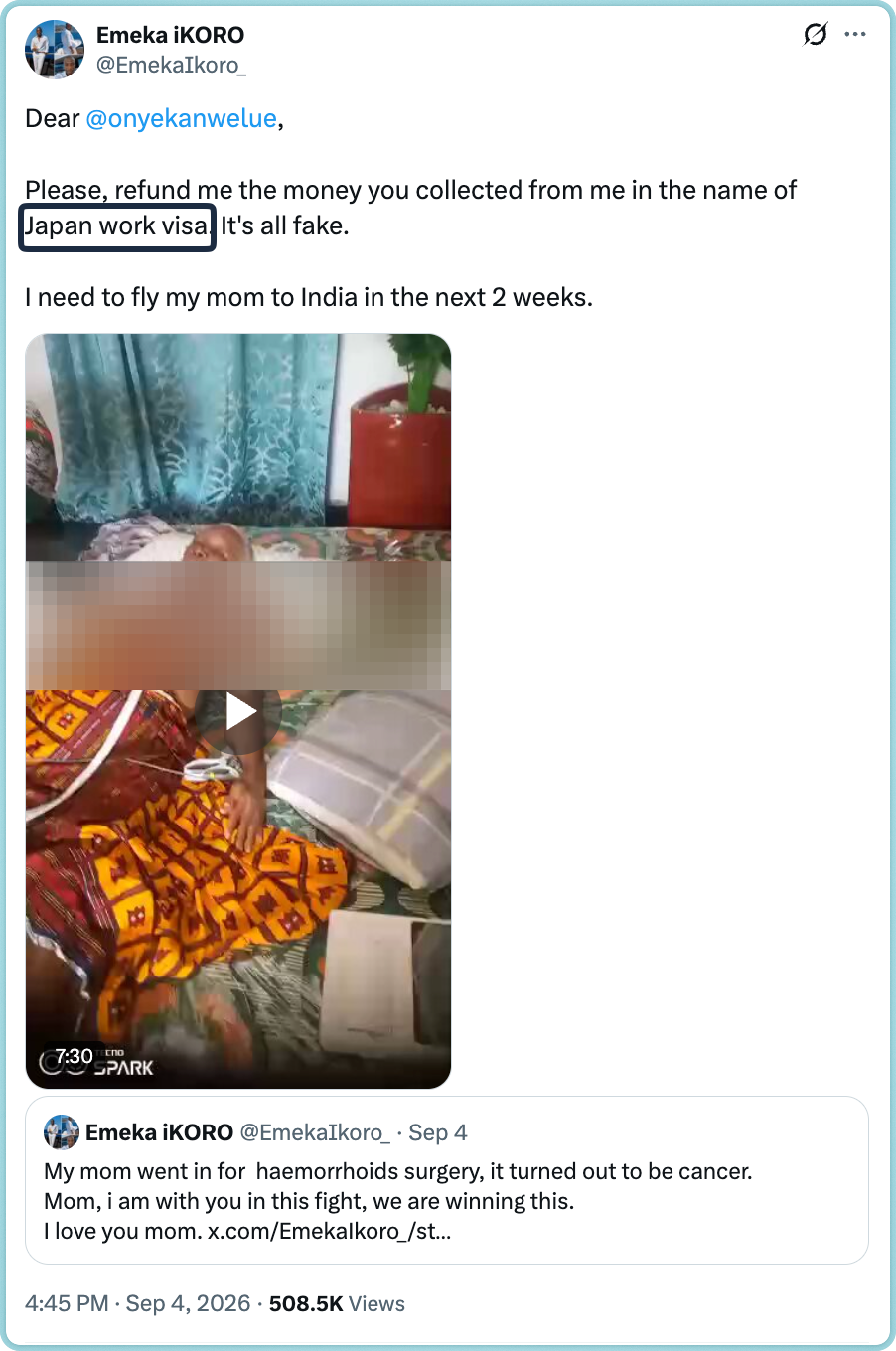
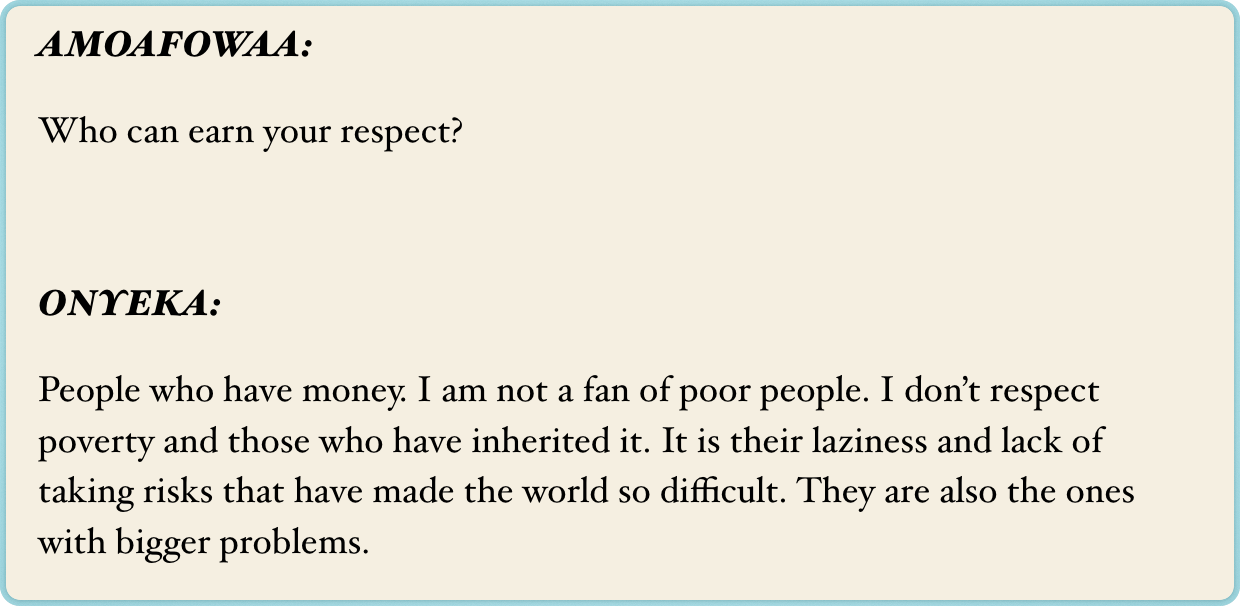
Obviously, being the drama/scandal-invested platform that it is, Nigerian Twitter/X quickly attracted the usual crowd of blue-check influencers offering commentary, jokes and hot takes, all part of what has become the familiar ritual for whatever new controversy is happening in the moment. But the larger interest from ordinary users appeared to come from the extraordinary contrast between the allegation and Nwelue’s now-famous “anti-poor” public persona.
For many people encountering the story for the first time, the surprise for them was mostly how someone who had spent so much time speaking contemptuously about poor people now himself be accused of taking millions of naira from someone seeking a route abroad?
But the surprise also revealed to me that most of the audience seemed unfamiliar with Onyeka Nwelue’s antecedents.
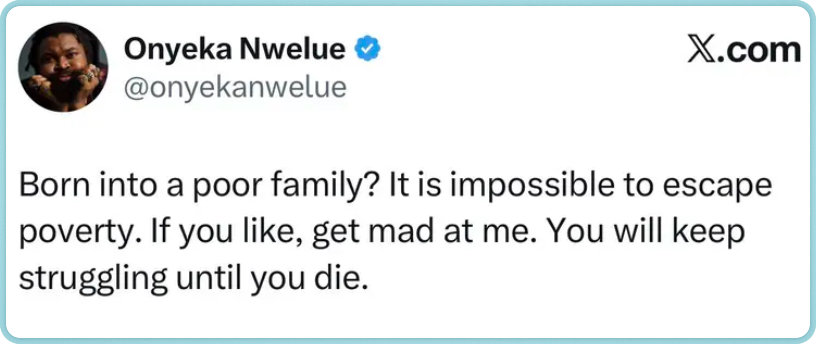
That misconception [or perhaps, more accurately, that absence of context and the lack of documented history] alongside the newer information that has emerged since Ikoro’s accusation, is one of the reasons this article exists.
The Man, Onyeka Nwelue
Seven months ago, the physician and writer Dami Ajayi wrote an introspective essay about Onyeka Nwelue in Culture Custodian titled “Professor Nwelue, I Presume?”
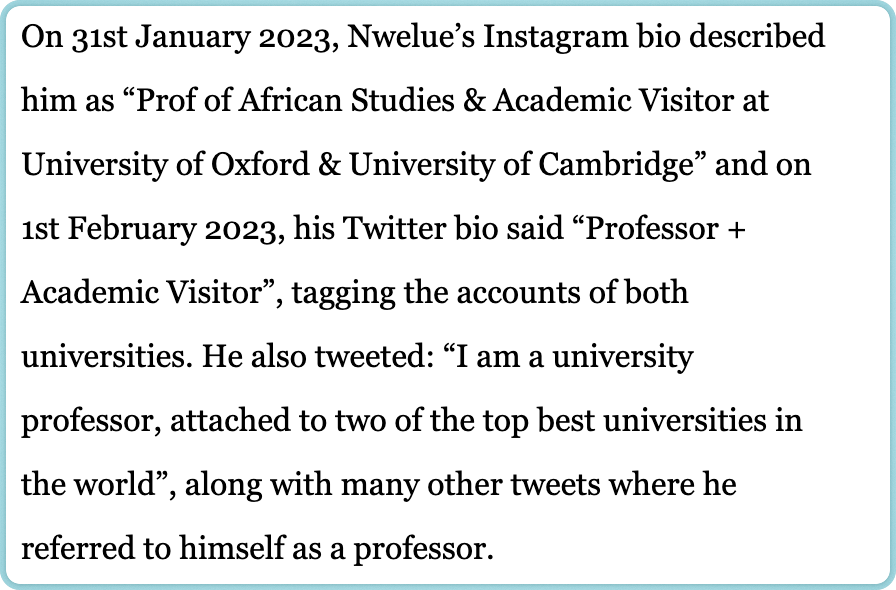
The “Professor” in the title was Dr. Ajayi referring, in part, to an earlier scandal from March 2023 at Oxford University involving Nwelue and David Hundeyin [a Nigerian “journalist” who, in more recent years, has attracted his own controversies and become the recurring subject of “CIA jokes” on the Nigerian internet].
That episode was extensively reported by Cherwell, Oxford’s oldest independent student newspaper. Nwelue had been admitted to Oxford as an unpaid Academic Visitor, but subsequently lost that status after allegations that he had misused university logos and premises for commercial purposes and presented himself publicly in ways that suggested he was an Oxford professor. It was a huge scandal at the time because Nwelue does not appear to possess an academic doctorate, and available biographical accounts do not even establish that he holds an academic master’s [or equivalent] degree either.
At Oxford, he had also founded an initiative called the James Currey Society and associated James Currey Fellowship. In a subsequent investigation, Cherwell reported allegations that the fellowship operated in ways that financially benefited people within Nwelue’s network.
One interesting detail was Mr. David Hundeyin’s selection as a James Currey Fellow at Cambridge in October 2022, shortly after he had signed a publishing agreement with Nwelue’s Abibiman Publishers the previous month.
Cherwell also reported complaints against Nwelue involving misogyny, racism and classism. I cannot independently speak to the allegations of racism and misogyny. The classism, however, is considerably easier to establish from his own public statements: Nwelue has repeatedly expressed extraordinary contempt for poor people.
At the crux of Dami Ajayi’s essay, the good doctor [now morphed into a pathologist for the purpose] was attempting something closer to the autopsy of Nwelue’s reputation and character, asking, in essence: what happened to this man?
Publicly available biographies commonly give Nwelue’s date of birth as 31 January 1988 in Ezeoke Nsu, Imo State, Nigeria. Yet primary British company records associated with companies he established [all now dissolved] record his birth month as March 1988. His father [of blessed memory] was described as a politician and his mother as a schoolteacher.
Nwelue is said to have studied Sociology and Anthropology at the University of Nigeria, Nsukka, where he reportedly left after two [or three] years without completing a degree. He has also said that he received a scholarship to study directing in Prague, although I have not found evidence [as at the time of writing] that this resulted in an awarded academic degree. At another point, he has claimed an honorary doctorate from an institution in Haiti identified as “Queensland University”.
While the distinction between an honorary doctorate and an earned academic doctorate is, of course clearcut, not at all semantic, Nwelue has at different points used the title “Dr”, creating an ambiguity around his academic qualifications that becomes particularly important when considered alongside the Oxford “Professor” controversy.
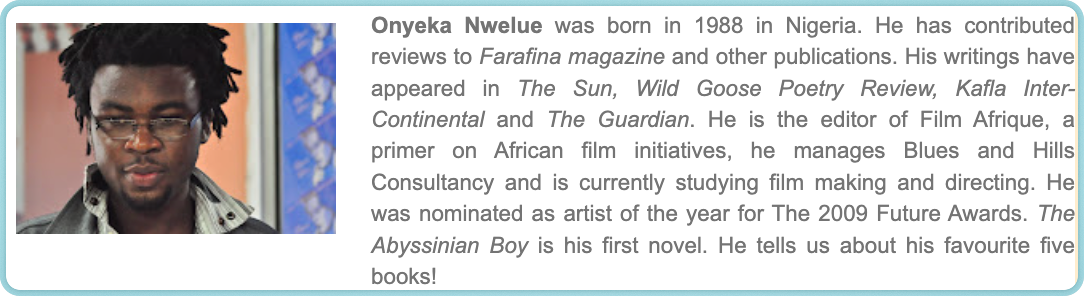
To his credit, Nwelue has actually produced artistic work. He directed the 2016 documentary “The House of Nwapa” and has (self-)published a very large number of books.
I will however not attempt an assessment of the artistic quality of his books or films because that is not the purpose of this article.
What interests me instead is a constant phenomenon Nwelue appeared to have exhibited through his public career: Nwelue has demonstrated an extraordinary ability to enlarge the appearance of his own accomplishments, attach himself to institutions and people with greater prestige, and then use those relationships to reinforce the mythology surrounding him. James Yeku has written about aspects of this tendency.
There is a formula to this process and Nwelue has mastered it thoroughly.
First, make a claim. Then repeat the claim in interviews. Allow the claim to appear in profiles, festival biographies and media articles. Those secondary references begin citing one another. After enough repetition, the original claim gradually becomes detached from the question of whether anyone ever independently verified it. Eventually, Google itself becomes the archive of the myth, and man [Onyeka in this case] has now successfully (re)created his own image.
Without digging much deeper, one might easily come away from a simple Google search of his name believing that Nwelue graduated with a Sociology degree from Nsukka, obtained a film degree in Prague, holds an academic doctorate, became a professor at Oxford, and created a prestigious Oxford fellowship.
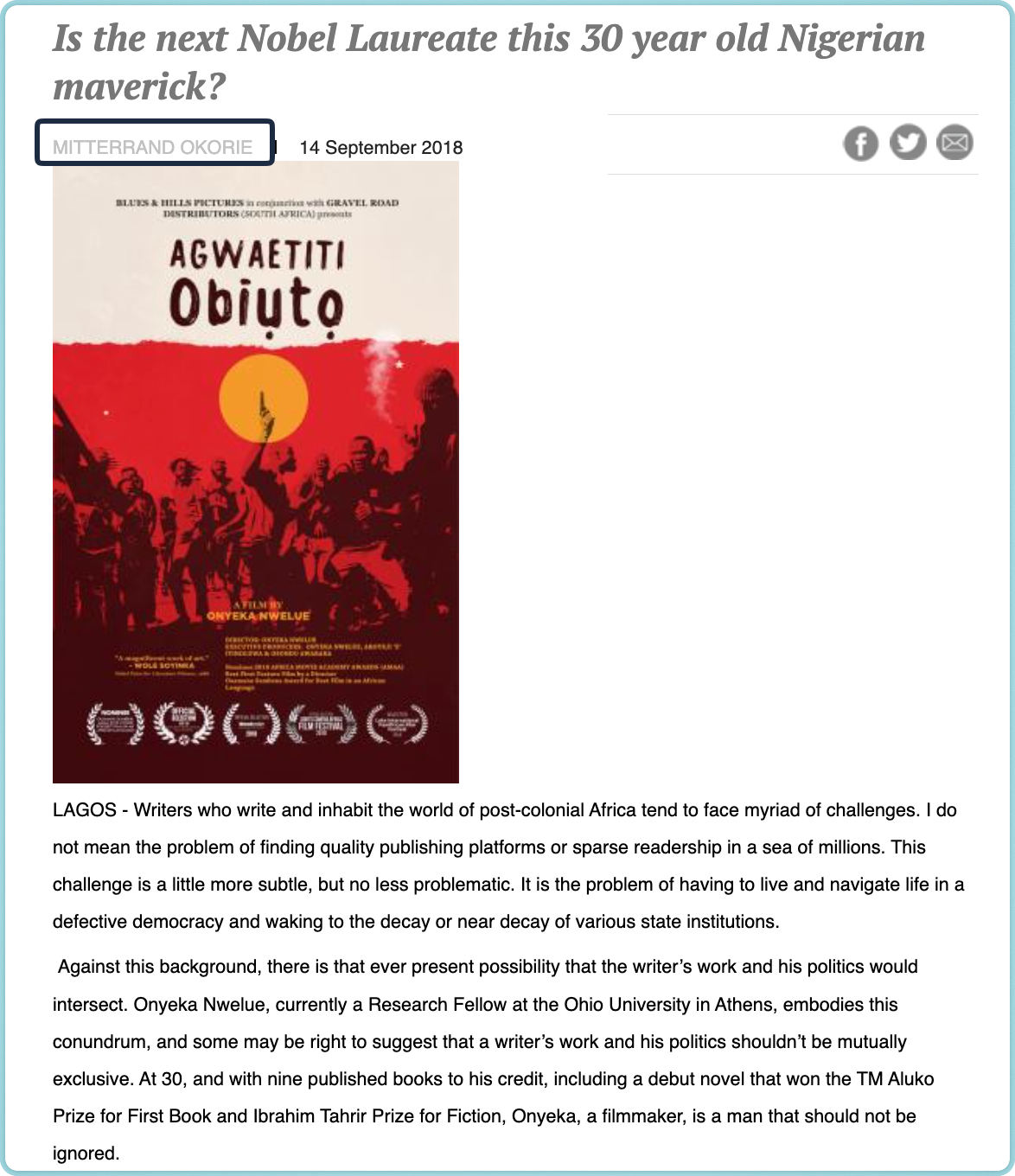
All of this becomes even easier when reinforced by real [or apparently real] relationships with prominent people. Over the years, Nwelue has publicly cultivated associations with figures including Prof Wole Soyinka, Dele Momodu, Rudolf Okonkwo, Prajwal Parajuly, Ikhide Ikheloa and so many others.
In plainer terms, Nwelue appears to have perfected an unusually sophisticated version of “fake it till you make it”: construct the image, cultivate relationships that authenticate the image, and allow the prestige of those relationships to shield the construction itself from scrutiny.
Onyeka Nwelue is, in that sense, a master player.
Nwelue Begins to Fly Too Close to the Sun
Certain things should be clear by this point, Onyeka Nwelue is a “smart” man. At least in the distinctly Nigerian sense of smart that Elnathan John so brilliantly anatomised in Be(com)ing Nigerian. Nwelue is socially aware. He appears strategic. He understands status, proximity, performance and perception remarkably well. He also seems to derive a huge part of his motivation from his fear [or more accurately, disdain] of poverty.
But even the most carefully maintained mythology has limits. And over the past year, three separate controversies appear to have pushed Nwelue’s survival model much closer to “Icaric” limits.
A. The Journalists Who Did Not Exist
In one recent scandal, Dispatch editor Jacob Furedi said he received a pitch from a supposed journalist named “Margaux Blanchard” about a Colorado settlement that appeared not to exist and he began to investigate.
According to his account for Dispatch, checks into “Margaux Blanchard” produced contradictory biographical claims and other details that raised increasingly serious questions about whether the journalist herself existed.
What had initially looked like a random encounter with “AI-era journalism” became considerably more interesting after the editor of Freelancing With Tim also described his own interaction with “Margaux”. He said he had commissioned work from the supposed journalist, became suspicious, and eventually discovered that the PayPal account supplied for payment was registered in the name Onyeka Nwelue, using an email address he said could be connected to Nwelue’s established online presence.
According to the editor’s firsthand account, when he contacted Nwelue seeking an explanation, Nwelue responded abusively.
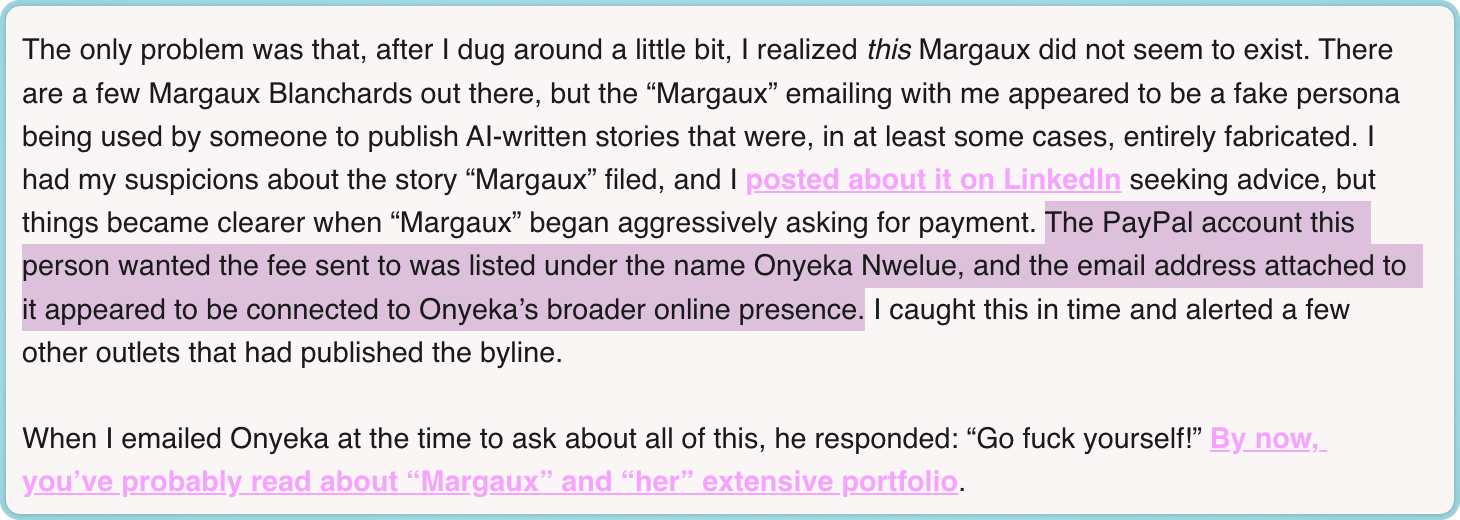
At that point, what initially looked like a random story about AI-assisted fabrication had now morphed into a question of whether one or more apparently invented freelance identities could be connected to a real/living Nigerian writer. The Washington Post also subsequently reported that Nwelue had been linked to the disputed byline.
Of course, Nwelue denied involvement in all cases and said his email account had been “compromised”.
B. The Japan Work-Visa Allegations
Onyeka’s newest scandal moves a step beyond inflated biographies or fake journalistic identities into allegations involving substantial sums of money.
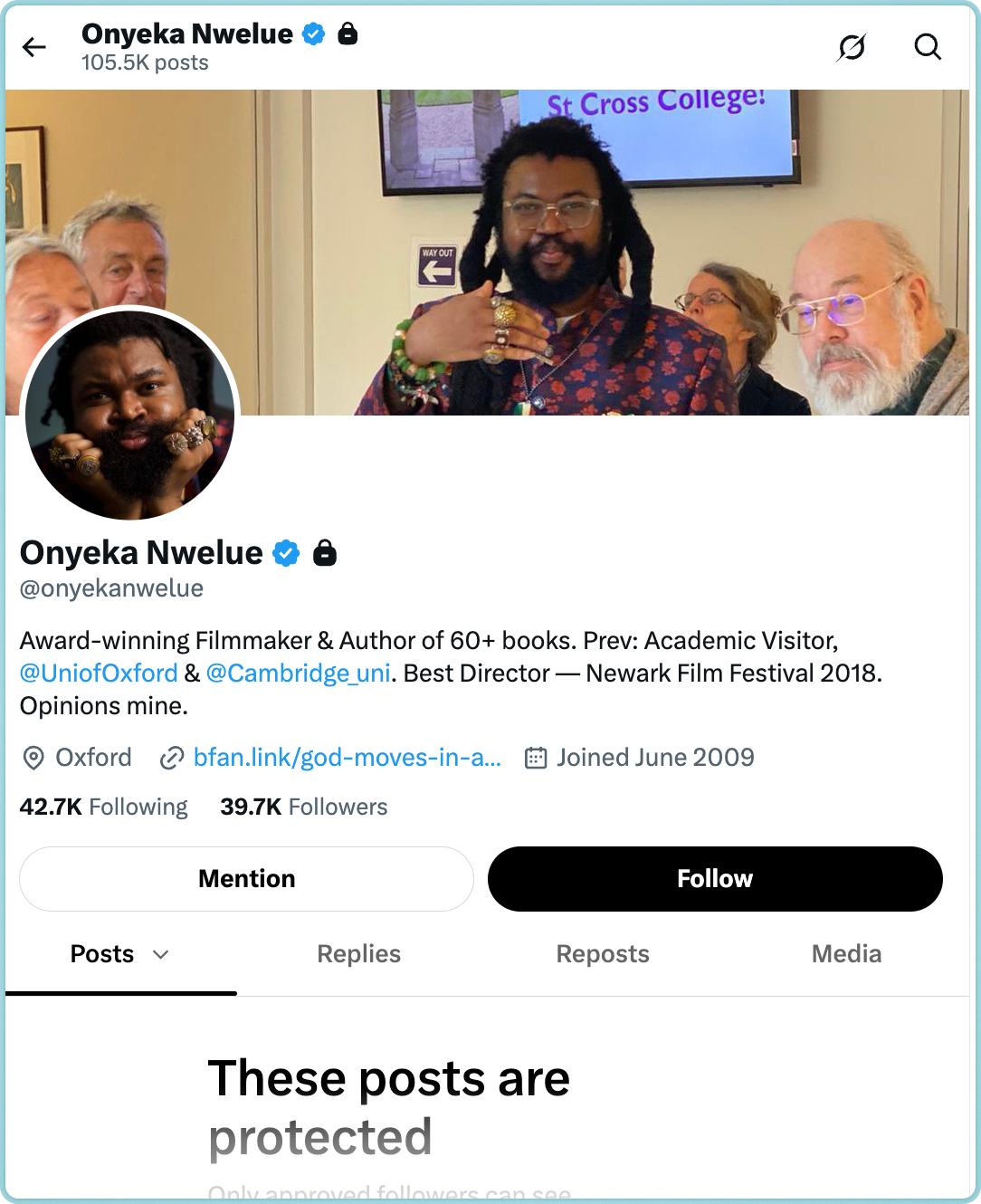
Nwelue is not, as far as I can establish, a licensed Japanese immigration lawyer, visa officer or registered immigration consultant.
Yet after Emeka Ikoro publicly accused him of taking money for a supposed Japanese work-visa arrangement, another Twitter/X user, Festus Ohalete (@ohalete_festus), published screenshots describing what he said was his own interaction with Nwelue.
According to Ohalete, the contact began through Twitter/X before moving to WhatsApp.
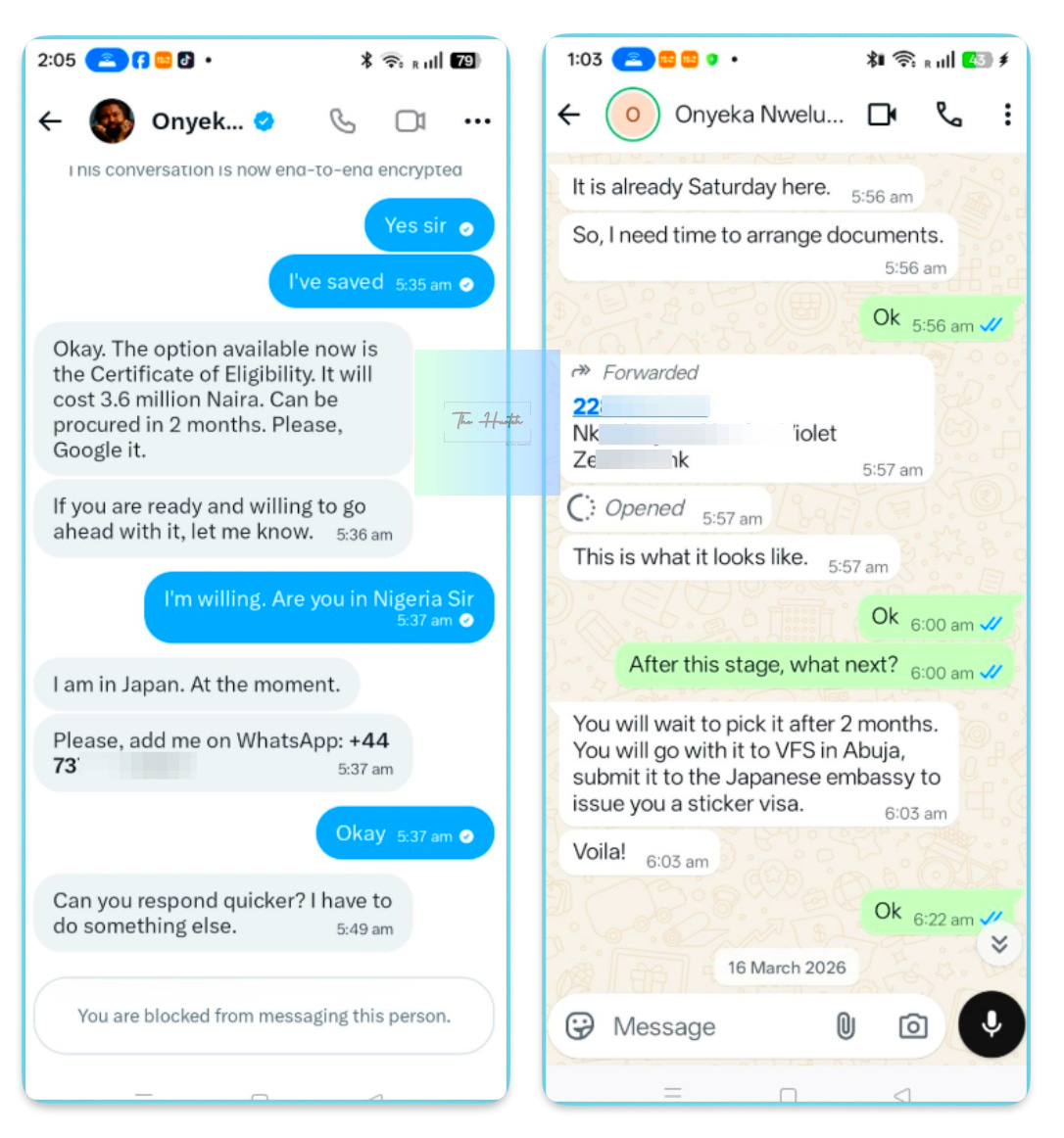
In the screenshots, the person identified as Nwelue allegedly requested ₦3.6 million for what was described as a Japanese “Certificate of Eligibility”. Ohalete said he ultimately did not pay. According to his account, once he hesitated or began asking questions, Nwelue blocked him.
This particular instance is even more interesting because one defence Nwelue has previously offered when confronted with disputed online material is that an account or email address of his had been hacked or compromised. In Ohalete’s case, however, the screenshots he published appear to show a continuity of communication: contact through Nwelue’s Twitter/X account, the sharing of a WhatsApp number, and the continuation of the conversation on WhatsApp.
There is another important detail. Several days before Ikoro’s public accusation exploded across Twitter/X, he had already inadvertently revealed more about the alleged arrangement while replying to a post by @QueenUjunwa1.
Ikoro said Nwelue had demanded ₦13 million from him for Japanese visa “processing”, but that he decided instead to “test” Nwelue with an initial ₦3 million payment. He now alleges that Nwelue has refused to refund that money.
Another user, @jomanintelz, subsequently claimed that he too had nearly entered a similar arrangement.
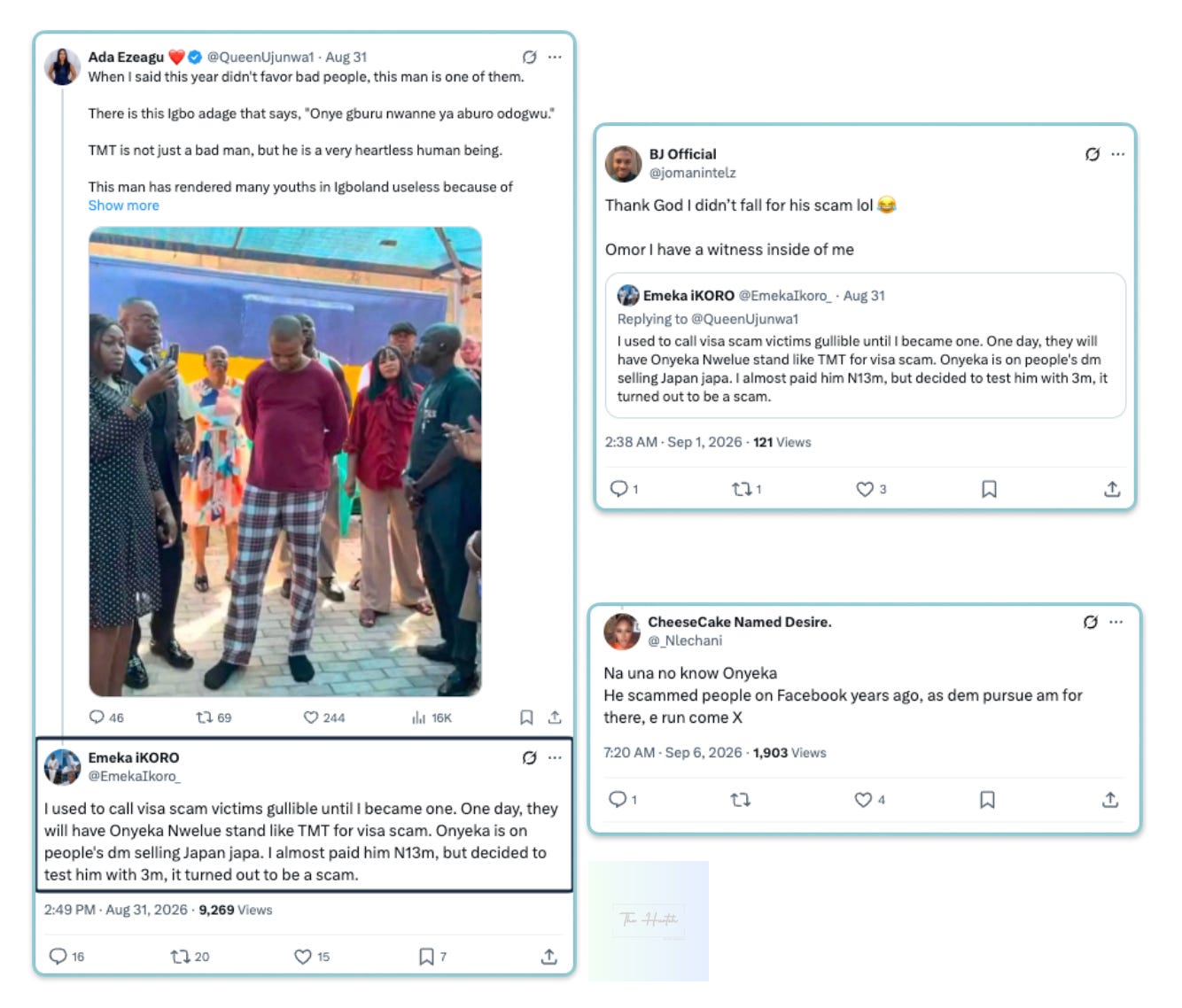
While all these remain allegations, the emergence of multiple people independently describing broadly similar [and consistent] Japan-related approaches lends some credence to their allegations.
C. Wole Soyinka, Japanese Residency and the Curious Case of Tokyo Spies
The third movement in Nwelue’s increasingly Icaric flight involves a public statement he made about Prof Wole Soyinka.
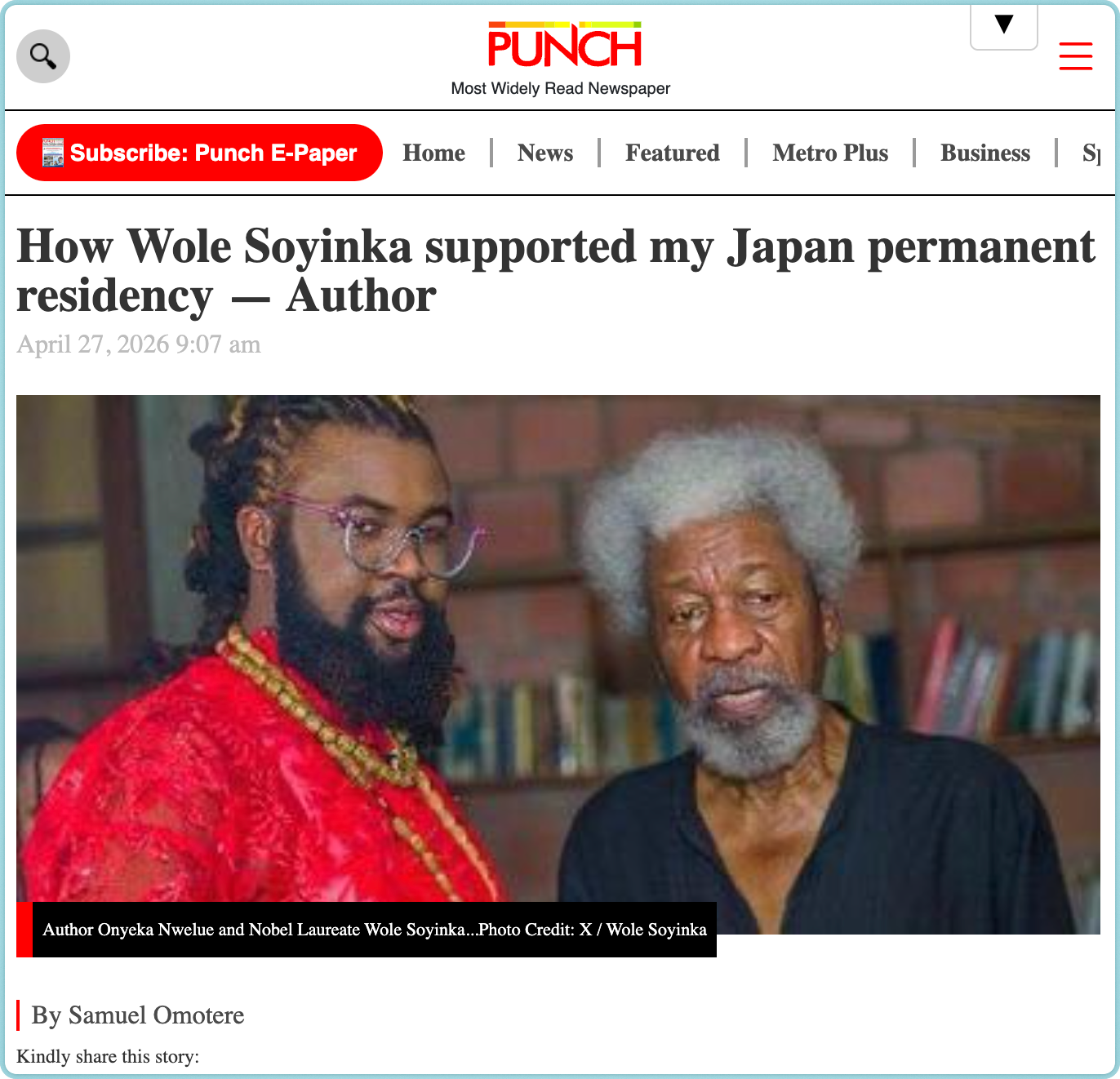
In April 2026, Nwelue was quoted in a Punch report saying that the Nobel laureate had written a letter supporting him in April 2025 and that the letter of support helped him secure “permanent residency” in Japan.
Then, in June 2026, approximately two months after the Punch article, Brittle Paper reported another extraordinary Nwelue claim: that he had secured a Japanese publishing deal worth almost $600,000 for a book titled Tokyo Spies.
To Brittle Paper’s credit, the publication made clear that it was reporting Nwelue’s claim and had not independently verified the publishing deal.
Nevertheless, their reporting contained several “curious” details and omissions.
First, it described Nwelue as the founding director of the “James Currey Society in Oxford” without giving readers the considerably more complicated history of the organisation or the Oxford controversy surrounding it or even its now defunct status.
Second, despite Nwelue having said only months earlier that he had obtained permanent residency in Japan, the Brittle Paper report merely described him as “currently residing in Osaka, studying Calligraphy”.
Third, the Amazon listing identifies Nwelue as the author, someone named “Prosper T” as editor, and Tokyo Prosser Press as publisher.
This is where the story becomes even more peculiar.
Searches I conducted in both English and Japanese did not produce an identifiable Japanese publishing house operating under the name “Tokyo Prosser Press”. The English-language results I found largely led back to reports reproducing Nwelue’s own announcement.
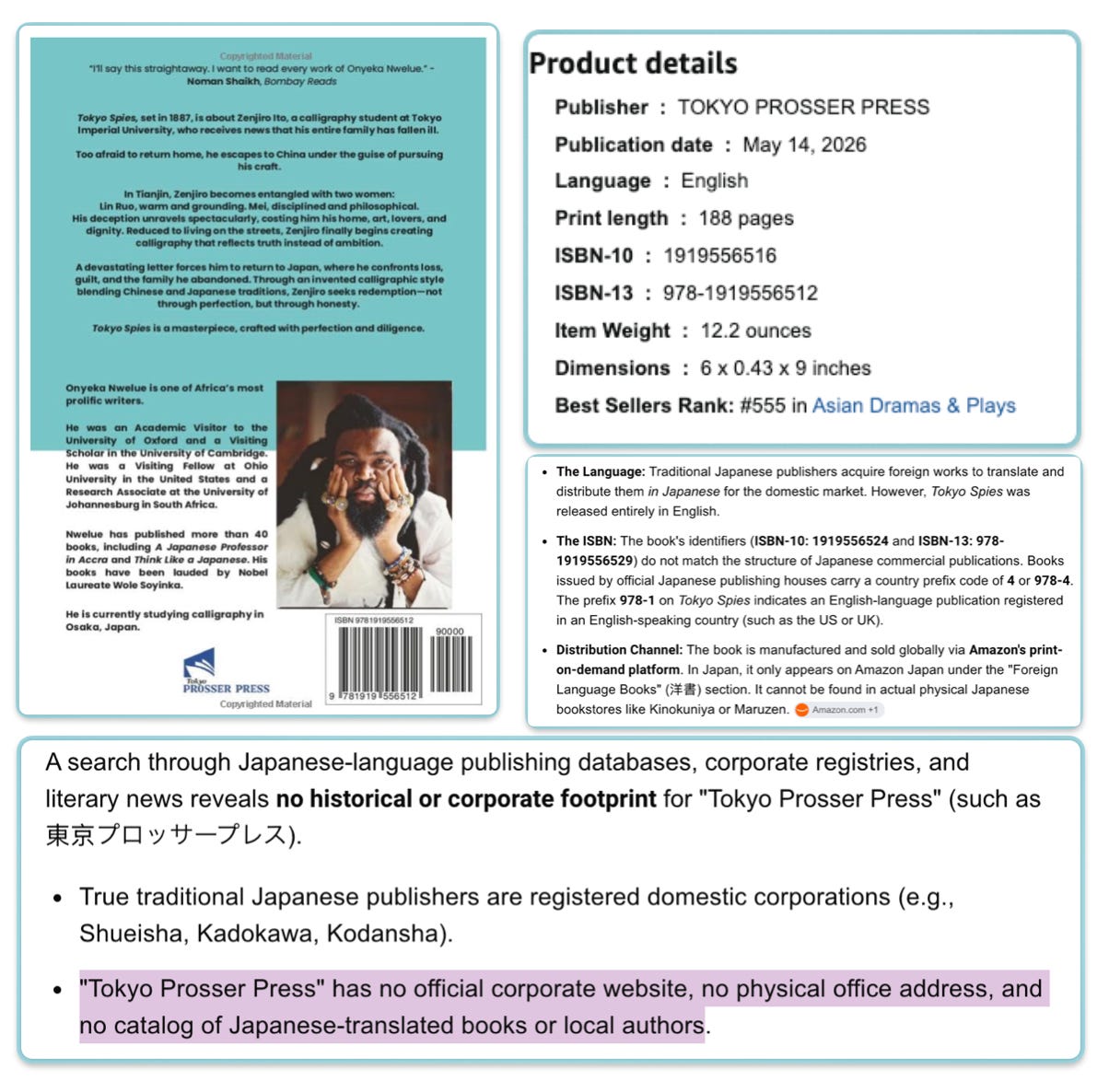
That does not allow me to state categorically that no such entity exists. It does, however, mean that I have not been able to independently verify the publisher, the reported acquisition, or the claimed value of the deal through ordinary publishing-industry, Japanese media or corporate sources.
The available Amazon listing also raises questions about whether Tokyo Spies may instead have been published through an entity associated with the author himself. If that is the case, a self-published or author-controlled book is not remotely the same thing as a Japanese publisher acquiring a manuscript for almost $600,000.
And again we encounter the same pattern: an extraordinary claim enters the public record because Nwelue makes it; Nigerian and international publications repeat it with varying degrees of qualification; subsequent searches then begin surfacing those articles as apparent corroboration of the original claim. The loop closes.
But the most serious development came after the Ikoro allegations. As discussion turned again to Nwelue’s Japan story, questions resurfaced about the letter he said Prof Wole Soyinka had written in support of his Japanese residency application. Mr. Gbenro Adegbola raised the earlier claim publicly, apparently concerned about the reputational implications for the Soyinka family.
Lola Shoneyin [celebrated Nigerian author and Soyinka’s daughter-in-law] responded:
Bros, let me jump in here. Concerned members of the family asked WS about the document @onyekanwelue posted on X a few months ago.
WS was very clear that he had neither written nor signed a letter presenting/recommending Onyeka Nwelue (for a visa or residence permit) to the Japanese government/immigration services/visa office.
Good afternoon, sir.
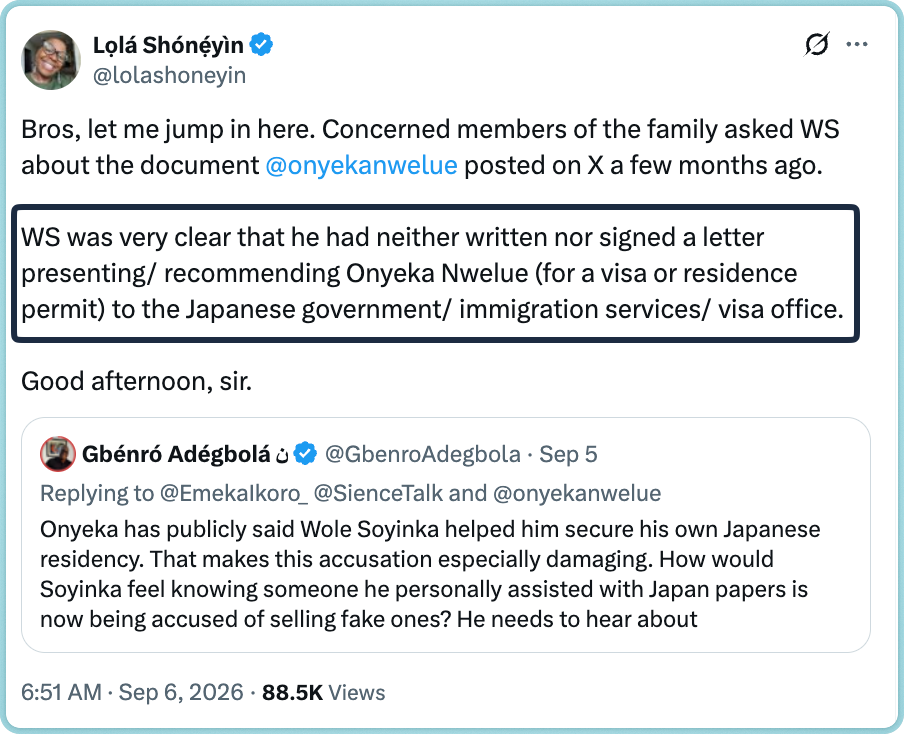
If Lola Shoneyin is accurately relaying Soyinka’s position, then one of two things requires explanation: either Nwelue’s earlier account of the letter was inaccurate [which means he falsely misrepresented Prof. Soyinka’s position in what’s likely legal immigration documents], or there is some other “mysterious” document or circumstance capable of reconciling the two accounts. Until Nwelue produces such an evidence, what is currently on record is his alleged misrepresentation [and use] of Prof. Wole Soyinka’s name and status.
The same applies to his immigration status. The publicly available information I have reviewed does not allow me to establish what Japanese residence status Nwelue currently holds. What it does allow me to say is that his reported claim of permanent residency now deserves substantially greater scrutiny, particularly because the Soyinka letter he cited in support of that story has been publicly denied by Soyinka’s family. Likewise, I have not found independent verification of the reported ¥85 million publishing acquisition for Tokyo Spies.
Conclusion
As I stated at the beginning, my motivation for writing this piece is quite simple.
It appears to me that a man with a long and documented history of embellishment, institutional misrepresentation and extravagant self-mythologising is now facing allegations of conduct far more consequential than calling himself a “professor” or exaggerating the prestige of a publishing deal.
The Japan visa allegations involve real people and, allegedly, real money. And one of the reasons stories like this can persist for so long is that the information exists in fragments. One controversy is buried in an Oxford student newspaper. Another lives inside an old interview. Another appears in British company records. Another exists as screenshots on Twitter. Another is repeated by a newspaper several years later without knowledge of what came before it.
The subject survives in the spaces between them. What has protected Nwelue for years, it seems to me, is not simply his talent for reinvention but the absence of a single record connecting all of his reinventions.
That is what I have attempted to provide in this article. This is not a declaration of criminal guilt. I am neither a court nor an investigative authority, and some of the most serious claims discussed here remain allegations made by identifiable people.
But there is enough in the public record to justify asking questions, and enough repetition in the pattern that people contemplating financial, publishing, professional or immigration dealings with Onyeka Nwelue would be wise to conduct their own independent verification before handing over money, reputation or trust.
Perhaps that is ultimately the value of a dossier like this: to ensure that the next likely “victim” is not forced to begin from ignorance. For years, Nwelue appears to have understood something important about reputation: if you tell a story about yourself often enough, and surround that story with sufficiently prestigious names and institutions, eventually other people begin telling it for you.
The internet remembers but unfortunately for him, it also remembers contradictions.
I rest my case.